Seven Virtues for Turbulent Times
Trevor introduces our sermon series for the autumn
Some of the most famous words spoken by Jeremiah are found near the beginning of the book named after him. In chapter 6, the ‘weeping prophet’ is warning God’s people of the need to repent of their sin and how dire will be the consequences of failing to do so. But the words of the prophet are not all doom and gloom. He also offers an alternative, life-giving option that may yet be pursued:
‘This is what the LORD says: “Stand at the crossroads and look; ask for the ancient paths, ask where the good way is, and walk in it, and you will find rest for your souls. But you said, ‘We will not walk in it.’” Jeremiah 6:16
The word translated as ‘ancient’ has a couple of different meanings – it doesn’t just mean ‘old’, but also has a sense of something which is enduring, or perpetual. In The Message, Eugene Peterson describes this as the ‘tried and true’ road, a turn of phrase that is memorable and typical of his flair with language. Another of my favourite commentators, Walter Brueggemann writes: ‘This return to ancient paths is not a nostalgic return to “old-time religion” or “the good old days”.’ Instead, God is summoning his people to the most fundamental truths about who is to be worshipped and who can be relied upon. Tragically, the invitation to the good way and rest is rejected by God’s people.
 God’s words spoken through Jeremiah are worthy of reflection at what feels like another crossroads moment in history. We look around us and see a world that seems more polarised than ever, with no consensus to be found about a way of reversing our economic decline. At times, it feels as if the stage belongs not to the voices of reason but to those who can shout loudest and generate most clicks with their hot takes and divisive rhetoric. We wonder who can be relied upon, when terms like ‘post truth’ and ‘alternative facts’ are now part of our everyday language.
What does Christian witness look like in a world like ours? We’ll seek to answer this question through the coming months, by way of reflection on ancient paths marked out for us by church leaders hundreds, if not thousands of years ago. Having spent last autumn considering ‘The Seven Deadly Sins’, this year we’ll turn our attention to ‘Seven Virtues for Turbulent Times’.
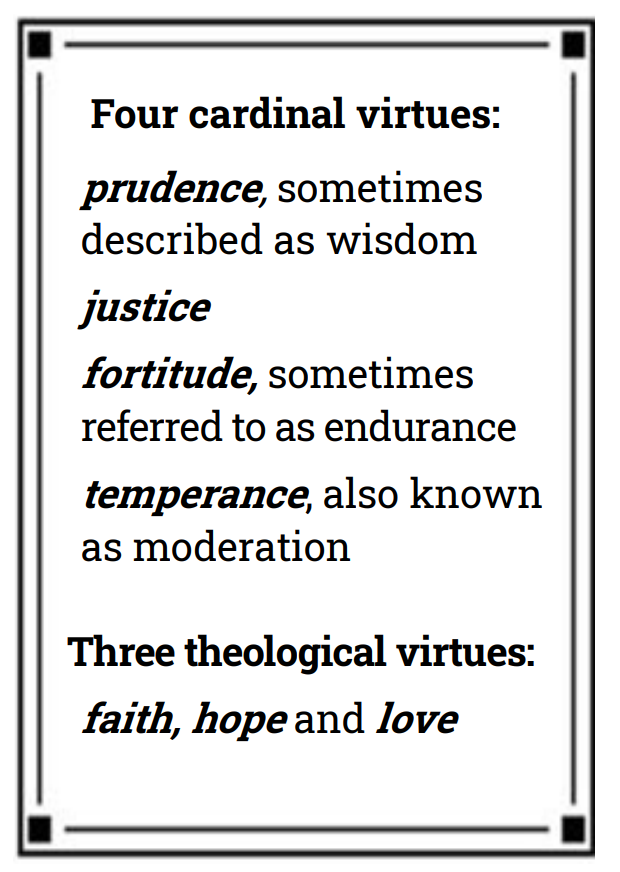
Over the course of church history, several significant leaders (including the likes of St Augustine and John Calvin) have emphasised the importance of these virtues, hallmarks of authentic Christian character. There hasn’t always been consensus on which virtues matters most, but one of the most famous lists is that drawn up by the famous medieval theologian, Thomas Aquinas. Aquinas spoke of four cardinal virtues: prudence, sometimes described as wisdom; justice; fortitude, sometimes referred to as endurance; and temperance, also known as moderation. And to these we can add what are usually spoken of as the three theological virtues: faith, hope and love.
There are no new words or ideas contained in these lists, nothing original. Instead, we will find ourselves drawn back to values and practices that have been cultivated by followers of Jesus for the last 2,000 years. As we walk in these ways, may we find rest for our souls and a means by which we can communicate something true, attractive and life-giving to our friends and neighbours.
31/08/2026